Samsung's $80 Billion Quarter Is a Warning on AI Compute Costs for 2027 | MMARW
MMARW / INTELLIGENCE / FINANCE
Samsung's $80 Billion Quarter Is a Warning on AI Compute Costs for 2027
Samsung just earned about $80 billion in one quarter, mostly from memory chips. That money comes from somewhere, and in 2027 a lot of it comes from AI compute buyers. Here is how to decide what to lock in now and what to leave flexible.AI-assisted publicationAI contributed to the research, drafting, or imagery. MMARW retains editorial responsibility for the published page.
10 min readPublished By MMARW
AI
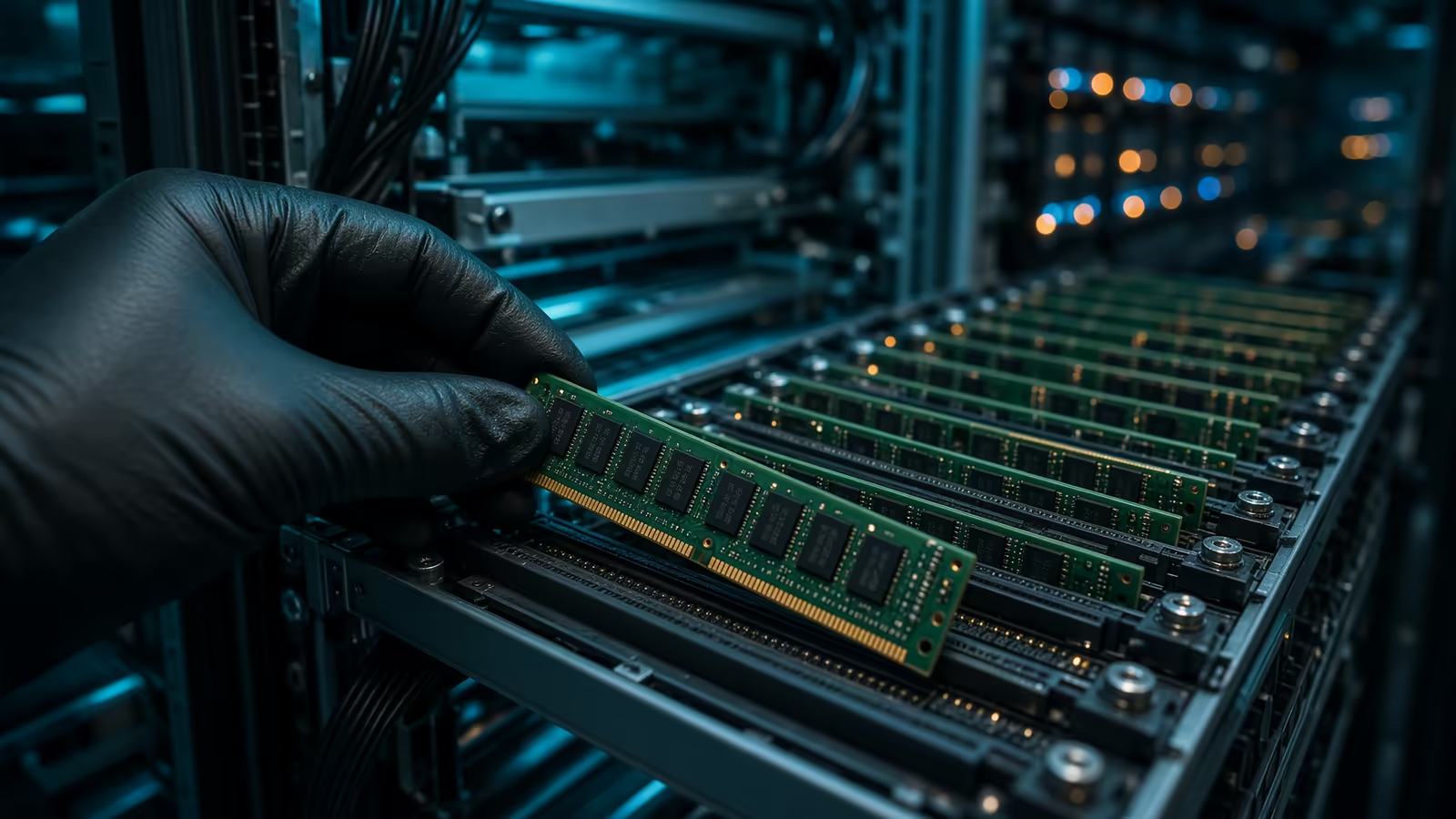
Samsung's record quarter: a warning on AI compute costs for 2027. · MMARW
Samsung's record-breaking operating profits signal a structural shift in memory pricing that will likely manifest as higher compute costs for enterprise and cloud buyers by 2027.
Thesis
The unprecedented scale of Samsung Electronics' Q3 2026 operating profit serves as a structural price signal for the AI compute market. Record earnings driven by high-bandwidth memory (HBM) and conventional DRAM/NAND shifts suggest that memory—rather than just logic—is becoming the primary binding constraint and cost driver in the AI hardware stack. For firms purchasing AI compute via cloud, on-premise hardware, or inference APIs, these profits indicate a period of sustained upward pressure on cost structures that will peak in 2027 as HBM4 cycles mature.
We recommend that procurement and finance leads move from a "growth-at-all-costs" flexible spending model toward a "defensive lock" model for their 2027 requirements. This means prioritizing multi-year capacity commitments and hardware purchases now to hedge against projected 121% year-on-year HBM ASP increases TrendForce: HBM 2027 outlook.
This recommendation remains valid as long as the supply-demand imbalance persists. If total AI workload demand undergoes a significant cooling, or if Chinese memory competitors successfully flood the market with alternative DRAM/NAND products, the necessity for aggressive locking diminishes. However, given current guidance from Samsung and Micron, the supply constraint is expected to persist into 2028 Reuters via The Star.
Samsung Electronics' Q3 2026 earnings guidance, published on 8 October 2026, reveals a massive acceleration in profitability. The company reported consolidated sales of approximately KRW 195 trillion (within a range of 194-196tn) and an operating profit of approximately KRW 107.4 trillion (range 107.3-107.5tn) Samsung Q3 2026 earnings guidance.
The magnitude of this growth is significant when compared to previous periods:
Quarter-on-Quarter (q/q): Operating profit increased approximately 20% from Q2 2026 (KRW 89.49tn) Reuters via The Star.
USD Conversion: At an exchange rate of KRW 1,339.57 per $1, Samsung's profit equates to roughly $80.17 billion Reuters via The Star. This is the first time a technology company has surpassed KRW 100 trillion in quarterly operating profit Reuters via The Star.
While Samsung did not provide a divisional breakdown in the guidance, market analysts have provided detailed estimates. Analysts suggest that memory-related products generated roughly KRW 110tn of the operating profit, effectively offsetting losses in other sectors such as smartphones and consumer electronics; specifically, the mobile unit is estimated to have lost more than $1bn The Korea Herald: Samsung tops KRW 100tn quarterly profit. One analyst estimate indicates that Samsung's HBM bit shipments rose nearly 50% quarter-on-quarter The Korea Herald: Samsung tops KRW 100tn quarterly profit.
The broader market for memory remains in a tightening phase. TrendForce reported that for Q4 2026, conventional DRAM contract prices are projected to rise 10-15% q/q (compared to a 60% jump in Q2) TrendForce: Q4 2026 memory contract prices. NAND Flash is projected to rise 15-20% in the same period TrendForce: Q4 2026 memory contract prices. Looking further ahead, HBM supply is expected to remain constrained through 2027, with a forecast that the blended HBM average selling price (ASP) will rise 121% y/y as HBM4 market share increases TrendForce: HBM 2027 outlook. Samsung and Micron have both indicated that the supply-demand imbalance is likely to persist into 2028 Reuters via The Star.
Why it matters for the reader's decision
The primary concern for a firm buying AI compute is not Samsung's quarterly profit itself, but the transmission mechanism that converts these chip-level price increases into enterprise-level expenses. This transmission occurs across four distinct layers:
1. The Hardware Layer (Bill of Materials)
GPU and ASIC vendors (such as NVIDIA or proprietary cloud silicon designers) do not operate in a vacuum. Their Bill of Materials (BOM) is heavily weighted by high-performance memory. As HBM prices rise and the industry moves toward HBM4, the cost of a single AI accelerator increases. Notably, current trends show GPU/ASIC vendors evaluating 8-Hi stacks, which carry an estimated 10-20% per-Gb premium over 12-Hi stacks TrendForce: HBM 2027 outlook. These premiums directly inflate the cost of on-premise server purchases.
2. The Cloud Infrastructure Layer
Cloud Service Providers (CSPs) face rising capital expenditures (CapEx) due to the aforementioned BOM increases. While CSPs benefit from economies of scale, they are not immune to the memory shortage. When DRAM and HBM supply is tight, the availability of the latest high-performance compute instances becomes a premium commodity. The cost of these instances—and the subsequent pricing of inference APIs—will likely reflect the rising cost of the underlying silicon.
3. The Long-Term Agreement (LTA) Lag
It is important to understand that price increases do not hit the market instantly. TrendForce notes that some suppliers' price increases lag behind current market conditions due to long-term-agreement (LTA) pricing mechanisms TrendForce: Q4 2026 memory contract prices. For the buyer, this means a "lag effect": today's record profits at Samsung suggest that while current contract prices might be stabilizing, the "shocks" of 2027's HBM4-driven price spikes are already baked into the future supply-demand math.
4. The Service Layer
For software-as-a-service (SaaS) firms providing AI-enabled work, these costs represent a margin threat. If a firm's API costs or server bills rise because of memory-driven silicon inflation, but their client contracts are fixed-price or lack cost-plus escalators, their profitability will contract.
To manage 2027 budget risk, firms must categorize their AI spend and apply different procurement strategies to each. There is no single "right" answer; the goal is to balance the cost of "locking in" (which prevents paying more later) against the risk of "over-committing" (which prevents taking advantage of potential price drops).
Procurement Options
Strategy
Definition
Best Used For...
Primary Risk
Lock
Long-term, fixed-price commitments (multi-year).
On-prem hardware; Reserved cloud capacity.
Paying a premium if prices drop or tech shifts.
Reserve
Guarantees capacity/availability without a fixed price.
Mid-term cloud compute; scaling workloads.
Price spikes during the term.
Float
Spot-market usage, pay-as-you-go, or flexible APIs.
Research/R&D; highly variable workloads.
Unpredictable and potentially massive cost spikes.
Category-Specific Decisions
A. Reserved/Committed Cloud Capacity
For predictable, production-level workloads, the "Lock" strategy is preferred.
Negotiation Lever: Seek price-adjustment clauses that cap increases or involve index-linked pricing based on a hardware/memory index rather than a flat percentage.
B. On-Premises Server Purchases
Since server hardware is a significant capital outlay, procurement should follow a "Lock" or "Front-load" approach.
Action: Accelerate hardware refreshes or purchase cycles before the full impact of the HBM4 premium is realized.
Negotiation Lever:Multi-vendor options and capacity guarantees to ensure that even if supply becomes tight, your orders are prioritized.
C. Model/API Spend
For firms relying on external LLM providers, the decision is between fixed rate-cards and usage-based models.
Action: For high-volume, steady-state inference, seek "Reserved Throughput" contracts. For experimental workloads, continue to "Float."
Negotiation Lever:Exit/step-down rights allow you to reduce commitments if your specific model architecture changes or if you migrate to a different provider.
The following scenario is an illustrative model intended to demonstrate budget sensitivity. It does not represent a forecast. We assume a mid-sized AI services firm with an annual AI compute/API budget of $2,000,000.
Because the exact "pass-through" percentage (how much a 100% rise in HBM price increases a cloud bill) is an open question, we use three different assumed pass-through sensitivities to show budget outcomes.
2027 Budget Sensitivity Model
Scenario
Memory Market Outlook (Assumed)
Pass-through Sensitivity to Bill (Assumed)
Estimated 2027 Budget Impact
Base Case
Moderate supply tightening; standard HBM4 ramp.
15% of memory cost increases pass through to user.
30% of memory cost increases pass through to user.
$2,400,000 (+20%)
Downside (Low Cost)
Demand slowdown; successful Chinese competition.
5% of memory cost increases pass through to user.
$2,050,000 (+2.5%)
Critical Interpretation:
If the firm chooses to Lock at the Base Case level ($2.15M) and the reality turns out to be the Upside ($2.4M), they face a $250,000 budget shortfall.
If the firm chooses to Float (relying on spot pricing) and the reality turns out to be the Upside, their costs could exceed the $2.4M mark significantly as CSPs pass through the full brunt of the HBM4 premiums.
Decision Rule: The "Lock" should be sized to cover the Base Case, while a contingency fund should be maintained for the Upside scenario.
What to do in the next 30 / 90 days
Management and procurement teams should treat the next quarter as a window for structural de-risking.
Next 30 Days: Audit and Modeling
[ ] Audit Existing Contracts: Review all current cloud and hardware contracts. Specifically, look for "price-adjustment" clauses that allow providers to unilaterally increase rates based on "market conditions."
[ ] Model Pass-through Sensitivity: Work with finance to create a "Compute Sensitivity Model" similar to the worked example above. Determine what a 10%, 20%, and 30% increase in your total AI spend would do to your gross margins.
[ ] Inventory Hardware Lifecycles: Identify any planned server refreshes for 2027. Evaluate the cost of pulling these forward into late 2026.
Next 90 Days: Execution and Mitigation
[ ] Identify Exit/Step-down Rights: For all API and cloud service providers, document the complexity and cost of moving workloads to a secondary vendor.
[ ] Draft Provisional 2027 Budgets: Do not build a single-number budget. Build a "banded" budget that accounts for the Base, Upside, and Downside scenarios.
[ ] Establish Monitoring Triggers: Assign a team member to monitor the specific "Signals to Watch" (listed below) and report when a trigger is hit.
Signals to watch and revisit triggers
The following events should trigger an immediate reassessment of your 2027 procurement strategy:
Samsung Full Q3 2026 Results (29 Oct 2026): Provides the actual divisional breakdown. If memory-driven profits are even higher than analyst estimates, the "High Cost" scenario becomes more likely.
SK Hynix and Micron Quarterly Results: These will confirm if the "imbalance" is a Samsung-specific issue or a systemic market-wide shortage.
TrendForce Q1 2027 Contract-Price Calls: This will be the first real indicator of how HBM4 supply is actually impacting contract prices.
Cloud Provider Price Announcements: Any public shift in "Reserved Instance" pricing or new "AI-optimization" surcharges.
HBM4 Shipment/Ramp Updates: News regarding the yield rates of new 16-layer or HBM4 stacks. Low yields will exacerbate supply shortages and drive prices higher.
Won-USD Exchange Rate: Since Samsung's costs and revenues are heavily influenced by the Korean Won, significant volatility here can impact Samsung's pricing power and global supply stability.
Risks and what this file does not tell you
This analysis is based on current market guidance and historical trends; several significant risks could invalidate these findings:
Demand Slowdown: The fundamental assumption is that AI workload demand remains high. A significant "AI winter" or a plateau in enterprise adoption would reverse the current supply-demand imbalance, making "Locking" high-priced capacity a major mistake.
Chinese Competition: While currently viewed as a secondary factor, any breakthrough in Chinese memory manufacturing (DRAM/NAND) could flood the market and deflate prices.
Exchange Rate Volatility: Significant strength in the Korean Won could affect Samsung's pricing and competitiveness.
Over-commitment Risk: There is a distinct risk of over-committing to 2027 capacity at what might be a local price peak, particularly if the HBM4 transition is smoother (and cheaper) than anticipated.
Limitations of this file:
This document does not provide specific pass-through percentages. The exact ratio of memory price increases to API or cloud instance increases is an open market question.
This document is not investment advice. It does not provide buy/sell/hold calls on Samsung, Micron, or any cloud provider.
This document does not forecast exact 2027 prices. It provides a framework for managing the uncertainty of those prices.
 AI