MMARW / INTELLIGENCE / AI
AI Agents vs Chatbots
A chatbot answers. An agent finishes the job. Most teams are still paying for the wrong one.AI-assisted publicationAI contributed to the research, drafting, or imagery. MMARW retains editorial responsibility for the published page.
5 min readPublished By MMARW
 AI
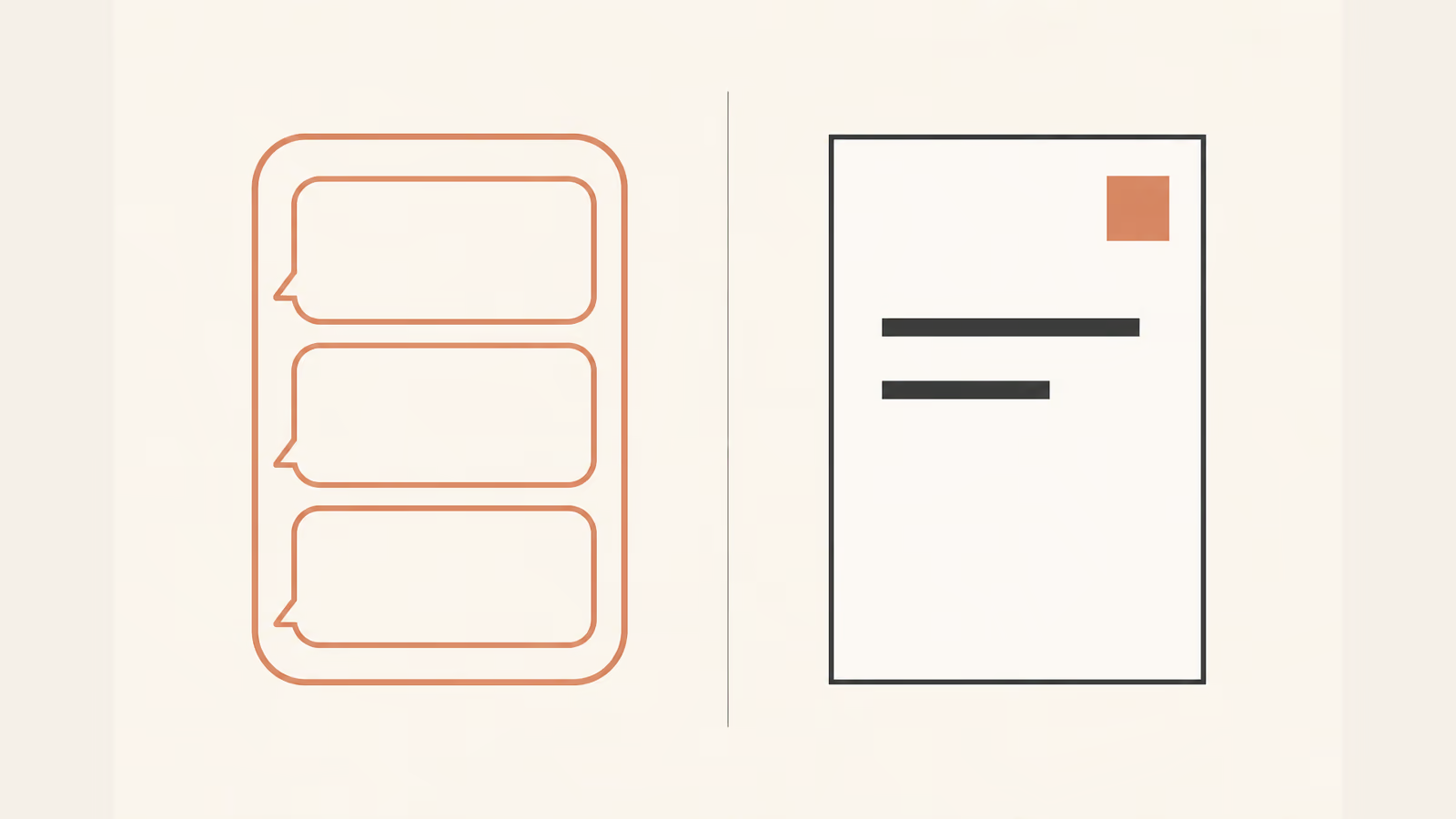
AIA chatbot answers the next message. An agent takes a job and tries to finish it. Most people are buying the second thing and still living in the first.
That mix-up is expensive. You pay agent prices for a chat window. Or you ask a chatbot to run a week of research and wonder why the output dies in the thread.
What each one actually is
A chatbot is a conversation. You ask, it replies, you ask again. The next step is yours. The work stays in the thread unless you copy it out.
An agent is a system that can plan more than one step, use tools, and keep going until a goal is met or it has to stop. Anthropic draws the line this way: a workflow follows a path you already wrote. An agent decides its own next tool call (Building effective agents).
The research name for that loop is ReAct: reason, act, look at the result, then decide again (ReAct). If there is no loop and no tool, you have a chatbot. If the model can search, write a file, or come back with a draft you can open, you are closer to an agent.
When a chatbot is enough
Use a chatbot when the job is one turn, or a few turns you are happy to steer.
- You need a first draft of an email and you will rewrite it.
- You want a definition, a rewrite, or a second opinion on a paragraph you already have.
- The source is already in the prompt. Nothing else has to be fetched.
- You are exploring. You do not yet know what the deliverable is.
A chatbot is the right tool for thinking out loud. It is a bad place to store the result. If the only copy of the work is the last bubble in the thread, you still do not have a file.
When you actually need an agent
You need an agent when the next step is unknown, and the work has to leave the chat.
- The job takes more than one look-up. A research report that has to check sources, drop dead links, and come back as a document.
- Something has to change outside the model: a file, a spreadsheet, a ticket, a workspace.
- You will be away. The system should keep going, then stop at a checkpoint you can review.
- The output has to be handed to someone else. A client does not read your chat history.
Anthropic's rule is the useful one: start simple. Add an agent only when a single model call, or a short chat, cannot do the job (Building effective agents). Agents cost more, take longer, and fail in longer chains. That trade only pays when the job is open-ended and the finish line is a file.
What breaks if you pick wrong
Ask a chatbot to "do the research" and you get a confident summary with no trail. You cannot see what it opened. You cannot hand the thread to a colleague without a 20-minute recap. The work evaporates when the tab closes.
Ask an agent to "just chat" and you burn credits on a loop that did not need tools. It searches when a sentence would have done. It writes a 12-page pack for a two-line question. The extra machinery is not a feature if the job was one reply.
The failure mode that actually hurts teams is the first one: treating a chatbot like an employee, then discovering on Friday that nothing was saved.
Side by side
Three jobs, two tools
Research. "What is an AI research report?" is a chatbot question. "Read these six sources, drop anything older than 2024, and write a two-page brief I can send" is an agent job. The second one needs a plan, tools, and a document at the end. MMARW already treats that document as the unit of work, not the thread (The Artifact Standard).
Inbox. "Rewrite this reply so it is shorter" is a chatbot. "Triage this week's unread, draft the five that need a human, and leave me a list" is an agent. If you still paste every email into a chat window, you do not have an inbox agent. You have a slower chatbot.
A report. "Give me three bullets on this topic" is a chatbot. "Produce the client-ready file: question, method, findings, sources, what we did not check" is an agent. The test is simple. Can someone else open the output without you in the room?
How to choose in thirty seconds
- Is the deliverable a sentence or a file?
- Does the model need to look something up, or is everything already in the prompt?
- Will you sit there for every turn, or should it run and come back?
Sentence, no lookup, you stay: chatbot. File, lookup, it comes back: agent. Mixed answers usually mean start with a chatbot, then promote the job once you know what "done" looks like.
If you want to feel the difference, do not debate the terms. Give the same brief to a chat window and to a workspace that can search, write, and save. The one that leaves you a URL is the agent.
Try that as a workspace on mmarw.com.
Sources
MMARW / INTELLIGENCE
Put the same discipline to work.
This publication was formulated by MMARW. Try the workspace free for your own focused AI work.